Laughter: “An Instant Vacation”

I was teaching a self-care class on Wednesday to hair stylists, who certainly do their share of counseling, when one commented she’d seen this great sign, “Laughter is an instant vacation.”  I agree wholeheartedly so when my younger daughter sent me this cat picture a few months ago, I saved it for when I need a good laugh and decided this week to share it with you.  Hope this tickles your funny bone.

"Jabba" the Cat

May “the force” of laughter be with you.  Enjoy your weekend!

PPD Recovery and Renewal

I was listening to a mother in our postpartum support group as she described small victories; she was recovering from postpartum depression (PPD) and was feeling good about herself and how far she had come. I wondered why more women don’t celebrate recovery and victory over depression, anxiety, grief, and other emotional challenges.

A few years ago while offering phone support, one mom mentioned that after recovering from PPD, her Mother-in-law said she didn’t like who she’d become. Why was that?  What was different about her? She’d emerged a stronger, more confident woman, able to voice her needs and take care of herself.  A well-fought victory!  We laughed about her mother-in-law’s reaction and celebrated the woman she is now who is so different than when I first spoke to her.

After two personal experiences with PPD, I like the woman and mother I have become. I feel strong for fighting and winning against PPD, to date it is the most difficult thing I have experienced in my life. Now I ask for what I want and take care of my needs. I have self confidence in who I am and my abilities as a mother. That terrible experience molded me into the person I am today. Today, celebrate the woman you are becoming and have become!

Real Moms Geralyn and Linda

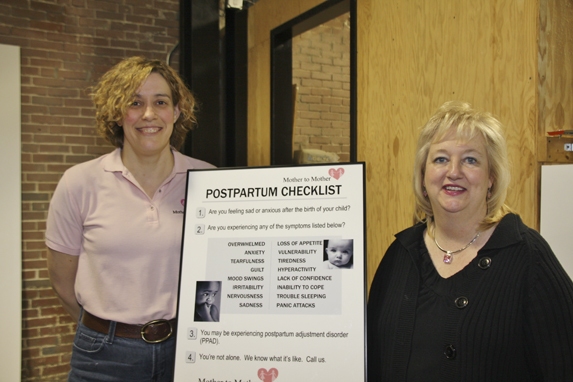
Linda Meyer is the Executive Director of Mother to Mother in St. Louis, MO. Mother to Mother offers telephone and group support to women experiencing emotional difficulties during pregnancy and postpartum.

Bonding With Your Baby

Bonding  prenatally and after delivery creates a foundation for the parent-child relationship.
Here are some bonding tips:

  1. Place your baby on your chest after birth and put a warm blanket over both of you. Hold, touch, and talk to your baby. Your body releases hormones that encourage bonding and attachment to your baby. You and baby do not need to be separated during the first hour after delivery unless there is a medical concern.
  2. Have dad take off his shirt and hold baby skin to skin.
  3. Massage your baby.
  4. Sing to your baby. Sing whatever you want, it doesn’t have to be kids music.
  5. Read to your baby. Read prenatally and post-delivery to your baby. Babies can hear in the womb and respond to your voice.
  6. Talk to your baby.
  7. Tell your baby “I love you.”
  8. Soak in the smell of your newborn. Who doesn’t like the smell of a newly washed baby?
  9. Your breastmilk is composed of the things you eat, so it tastes different at each feeding. Eat a variety of foods to treat yourself and your baby.
  10. Smile! Babies love faces and newborns can see from their mother’s breast to her face.
  11. Use a wrap, sling or carrier and keep your baby close to you.
  12. Play with your baby during diaper changes. Peek-a-boo and This Little Piggy are fun games.

Jamie Bodily is founder and director of ParentsCount. Jamie offers private and group “Happiest Baby on the Block” classes encouraging gentle baby calming for fussy babies.  For more-www.parentscount.com.

More Spring Cleaning

Here are some additional thoughts on how to renew ourselves and release old, worn thoughts and habits.  Spring cleaning from the inside out.

Discover what’s nourishing.  Just as plants need water and sunshine to grow, we need physical, emotional, and spiritual sustenance.  Start with eating healthy foods, getting regular physical activity, sleeping 8-9 hours, and taking breaks for your mind and body.  Do one thing you enjoy daily, whether it’s phoning a friend, listening to music or walking your dog.  Nurture your spirit through prayer, meditation, or communing with nature. 

Let go of un-nourishing relationships.  Being honest about admitting and detaching from relationships which aren’t good anymore can still hurt especially   ones involving family and long-term friends.  If we’ve spoken to them about what needs to be different and things haven’t changed over time, release them with love.   Clearing space for nourishing relationships to enter.

Cultivate optimism.  Looking more on the “sunny” side of life can be learned by shifting attention away from negative thoughts to more positive ones.  There are few situations which are all good or all bad.  Our great job may sour when we get a new boss.   An untimely move lead to a wonderful neighborhood with friends with love.  Prune your mind of unnecessary negativity. 

Practice gratitude

Photo by Real Mom Kim

When we feel grateful, our souls are nourished and restored.  We have a more positive attitude toward today and what lies ahead.  We feel connected to something bigger than ourselves.  Supported in the deepest sense.  Abundant and alive.

Hello, Me. Long Time No See.

Something happened when I became a mother.

I became disconnected from my thoughts, feelings and desires. With two little people depending on me, I spent my time on their needs and wants. When I wasn’t taking care of them, I shifted my attention to my work, husband and home life. Then, back to the kids.

Gone were the childfree days of college and young professional life, when I would spend hours alone, contemplating my place in the world, journaling (oh, the journals I have filled!), taking long walks in the woods, imagining life’s possibilities and going after them one by one.

As a mom, my only times alone with my thoughts have been 10 minutes in the shower or commuting to work. And guess what I was thinking? “Man, this shower feels good” or “I really hate this $#&@ing traffic.” Deep stuff.

Perhaps because my almost-5-year-old is more independent and my 19-month-old is no longer a baby, I’m now emerging from the mom-cocoon. It also helps that I work for myself, from home, with child care. As I poke my head (antennae?) out, I’m looking around saying, “What about me? What do I want?”

I’m allowing myself to move up my priority list. How do I want to spend my time? What do I want to experience or accomplish? It’s exciting to ponder these questions. I’m still a mom, with all the responsibilities and joys that come with it. But I’m also a person — who’s enjoying getting reacquainted with herself again.

Today’s author Susan is co-founder of Working Moms Against Guilt.

Motherhood is Hard Work So Cut Yourself Some Slack!

The media creates images of perfect mothers such as June Cleaver and Claire Huxtabel. TV moms look perfect, have spotless homes, and great relationships. Magazine covers portray moms holding beautiful babies, breastpumps and briefcases who are perfectly made up.  From such images women define their “shoulds” and “musts”creating unattainable standards of perfection and judging themselves for not keeping up.

The truth is that motherhood is hard work. As women become mothers and face the accompanying stressors and challenges, they often internalize their  inability to cope flawlessly as personal failings.  Add sleepless nights and fussy babies and it’s not hard to see why mothers lose confidence. When the idealized view of one’s self and motherhood collides with reality, they criticize themselves rather than recognizing how well they are doing given the endless expenditure of physical, emotional and mental energy that goes into caring for children.  Pretty amazing!

Nuclear families encourage isolation, especially in the early days postpartum. Experienced mothers rarely discuss hardships inherent in mothering.  No one wants to admit they felt less than adequate, irritable, anxious or depressed maneuvering new motherhood while this is true.  Although the internet provides some connection, many moms lack the  face-to-face support needed to see that everyone faces challenges and make mistakes.  Supporting themselves and each other by acknowledging that motherhood is hard work and that perfection must be tempered by reality  is what’s needed.

So, starting today cut yourself and the moms around you some slack.  You’ve earned it.  You deserve it!

Jamie Bodily is founder and director of ParentsCount which provides birth and postpartum doula services, childbirth education and counseling

Spring Is In the Air: Time for Emotional Cleaning

Spring is in the air.   As the days get longer and the weather warms, we feel a growing urge to refresh and renew our lives.  The blossoming season brings with it the opportunity to release what we’ve held on to mentally or emotionally, which no longer fits.  Spring cleaning indeed.

Clearing away old beliefs.  Just like our physical space, our minds are often cluttered with wornout beliefs and ideas.  In cognitive therapy, clients learn to monitor their negative beliefs and refute them.  If someone grew up being criticized, they may have the belief “I’m no good”.  As an adult however, they may have a successful career or be a caring parent, evidence that this belief is not true.  Changing automatic assumptions is empowering and liberating. 

Sow the seeds of intention: Step One.  Along with releasing negative thoughts, we must clarify what we want.  Why is this challenging?  First, our minds  chatter constantly over urgent but not important matters.  Like what we said that offended someone we hardly know or putting the laundry away.  Instead, we need to quiet our “monkey mind” through prayer, meditation and relaxation.   Stillness allows connection with our deeper selves.

Sow the seeds of intention: Step Two.  When our mind is still, we see more clearly how we want to live.  Then during our daily meditation/prayer, we can set our intentions for serenity, peaceful relationships, health, etc., allowing our intention and energy to flow in the direction we desire.  Creating the life we want one day at a time.

Beyond Self-Care: Hope for Postpartum Depression

Sometimes all a mom needs is hope. When buried under the despair of postpartum depression (PPD) or anxiety, it’s hard to imagine a light at the end of the tunnel. The doctor might tell you it’s there, but you don’t see it.

You need proof.

Since there’s no crystal ball to show you the happiness you’ll regain, you have
to get the proof another way. You have to talk to moms who have been there,
living examples of a full recovery from PPD. They exist. In fact, they are
everywhere.

I love connecting moms to others who have been down the same road.  Nearly one million women suffer from perinatal mood and anxiety disorders like PPD, and I want them to know they are not alone and that they will get better.   I’ve seen many times that all it takes is a few words from a mom who has been there to a mom with PPD, who’s feeling isolated and lost, to realize help is available and that she is worth it.

 To offer women with postpartum depression and anxiety  hope and support, I founded Postpartum Progress and Daily Hope, the nation’s first daily support service featuring emails to moms with postpartum depression and anxiety.  Both provide encouragement from survivors, the country’s top perinatal mental health specialists and others who care.  If you or someone you love has PPD, help is only a click away.

Today’s author is Katherine Stone, PPD survivor and spokesperson.

Cloth or Disposable…And Other Choices Moms Must Make

As soon as a woman announces that she has a positive pregnancy test, everyone has their advice and questions on choices she must make.  Will you have an epidural or not?  Will you use cloth or disposable? and the list goes on.  This myriad of opinions can feel overwhelming, confusing, and even irritating as a woman begins her journey towards motherhood.

Because women have been conditioned to nurture and please others, we agonize over choices, worrying we are going to hurt someone’s feelings by not doing it their way or that we will make a “wrong” decision and harm our children.   Society exerts considerable pressure to conform and attain a level of perfection in mothering that is impossible. 

But parenting is more of an art than a science.  Intuition is as important as what experts say.  Learning to be ourselves and accept our choices, whether they conform or differ from others, is an important part of the journey of becoming a mom.  The ability to transcend the opinions of others and make our own best choices enables us to become the mothers our children need instead of anxious, guilt-ridden mothers subject to the popular opinions of the media or others. 

Following our intuition means we must take time to know ourselves, to nourish ourselves and to trust ourselves; it means we must take time for self-care or the voices around us will drown our own.

Jamie Bodily is founder and director of ParentsCount which provides birth and postpartum doula services, childbirth education and counseling.

It’s Okay to Speak Up, Really (Part 3)

Here are the final four steps in assertive communication.  Hopefully, these will  help with both speaking up and listening.

  1. Provide clarification.  If the receiver doesn’t understand what you’re saying, clarify it.  However,  just because you say things clearly, doesn’t mean that’s how they’ll be heard.  If problems persist, make certain that you’re communicating openly and non-defensively and suggest resuming the conversation later if you want.
  2. Create a new opportunity.  As long as we’re alive, we can have a follow-up or “recovery conversation” when we’re not satisfied with a prior outcome.  First, all parties must agree to this.  Next, remember that each person is responsible for approaching the “recovery” conversation in an open-minded, non-defensive way intending to listen and be heard.  With this goal,  everyone wins.
  3. Ending the conversation.  If the other person becomes attacking or abusive, it’s time to stop. If you want, you can offer to have a “recovery conversation” later.  Whatever the choice, it’s yours.  Being assertive doesn’t  mean tolerating abusive behavior or language.  It does mean standing up for yourself and setting limits.     
  4.  Be clear about your intentions.  Assertivenes requires admitting to yourself whether you’re genuinely interested in open and honest communication or proving you’re right and other self-serving motives.  If intentions aren’t aligned with what’s best for the relationship , you won’t succeed.  When aligned, there are limitless possibilities for positive results.

Next week we’ll be discussing the new 7-week self-care challenge starting March 21.  If you participated in our October 21-day self-care challenge, we’d appreciate your comments and ideas on how to improve your experience.