PPD Recovery and Renewal

I was listening to a mother in our postpartum support group as she described small victories; she was recovering from postpartum depression (PPD) and was feeling good about herself and how far she had come. I wondered why more women don’t celebrate recovery and victory over depression, anxiety, grief, and other emotional challenges.

A few years ago while offering phone support, one mom mentioned that after recovering from PPD, her Mother-in-law said she didn’t like who she’d become. Why was that?  What was different about her? She’d emerged a stronger, more confident woman, able to voice her needs and take care of herself.  A well-fought victory!  We laughed about her mother-in-law’s reaction and celebrated the woman she is now who is so different than when I first spoke to her.

After two personal experiences with PPD, I like the woman and mother I have become. I feel strong for fighting and winning against PPD, to date it is the most difficult thing I have experienced in my life. Now I ask for what I want and take care of my needs. I have self confidence in who I am and my abilities as a mother. That terrible experience molded me into the person I am today. Today, celebrate the woman you are becoming and have become!
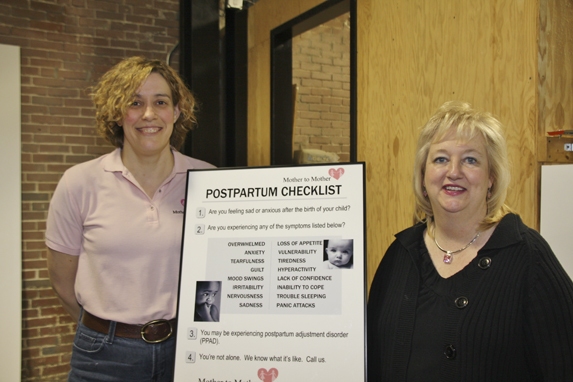
Real Moms Geralyn and Linda

Linda Meyer is the Executive Director of Mother to Mother in St. Louis, MO. Mother to Mother offers telephone and group support to women experiencing emotional difficulties during pregnancy and postpartum.

Motherhood is Hard Work So Cut Yourself Some Slack!

The media creates images of perfect mothers such as June Cleaver and Claire Huxtabel. TV moms look perfect, have spotless homes, and great relationships. Magazine covers portray moms holding beautiful babies, breastpumps and briefcases who are perfectly made up.  From such images women define their “shoulds” and “musts”creating unattainable standards of perfection and judging themselves for not keeping up.

The truth is that motherhood is hard work. As women become mothers and face the accompanying stressors and challenges, they often internalize their  inability to cope flawlessly as personal failings.  Add sleepless nights and fussy babies and it’s not hard to see why mothers lose confidence. When the idealized view of one’s self and motherhood collides with reality, they criticize themselves rather than recognizing how well they are doing given the endless expenditure of physical, emotional and mental energy that goes into caring for children.  Pretty amazing!

Nuclear families encourage isolation, especially in the early days postpartum. Experienced mothers rarely discuss hardships inherent in mothering.  No one wants to admit they felt less than adequate, irritable, anxious or depressed maneuvering new motherhood while this is true.  Although the internet provides some connection, many moms lack the  face-to-face support needed to see that everyone faces challenges and make mistakes.  Supporting themselves and each other by acknowledging that motherhood is hard work and that perfection must be tempered by reality  is what’s needed.

So, starting today cut yourself and the moms around you some slack.  You’ve earned it.  You deserve it!

Jamie Bodily is founder and director of ParentsCount which provides birth and postpartum doula services, childbirth education and counseling

Beyond Self-Care: Hope for Postpartum Depression

Sometimes all a mom needs is hope. When buried under the despair of postpartum depression (PPD) or anxiety, it’s hard to imagine a light at the end of the tunnel. The doctor might tell you it’s there, but you don’t see it.

You need proof.

Since there’s no crystal ball to show you the happiness you’ll regain, you have
to get the proof another way. You have to talk to moms who have been there,
living examples of a full recovery from PPD. They exist. In fact, they are
everywhere.

I love connecting moms to others who have been down the same road.  Nearly one million women suffer from perinatal mood and anxiety disorders like PPD, and I want them to know they are not alone and that they will get better.   I’ve seen many times that all it takes is a few words from a mom who has been there to a mom with PPD, who’s feeling isolated and lost, to realize help is available and that she is worth it.

 To offer women with postpartum depression and anxiety  hope and support, I founded Postpartum Progress and Daily Hope, the nation’s first daily support service featuring emails to moms with postpartum depression and anxiety.  Both provide encouragement from survivors, the country’s top perinatal mental health specialists and others who care.  If you or someone you love has PPD, help is only a click away.

Today’s author is Katherine Stone, PPD survivor and spokesperson.

It’s Okay to Speak Up, Really (Part 3)

Here are the final four steps in assertive communication.  Hopefully, these will  help with both speaking up and listening.

  1. Provide clarification.  If the receiver doesn’t understand what you’re saying, clarify it.  However,  just because you say things clearly, doesn’t mean that’s how they’ll be heard.  If problems persist, make certain that you’re communicating openly and non-defensively and suggest resuming the conversation later if you want.
  2. Create a new opportunity.  As long as we’re alive, we can have a follow-up or “recovery conversation” when we’re not satisfied with a prior outcome.  First, all parties must agree to this.  Next, remember that each person is responsible for approaching the “recovery” conversation in an open-minded, non-defensive way intending to listen and be heard.  With this goal,  everyone wins.
  3. Ending the conversation.  If the other person becomes attacking or abusive, it’s time to stop. If you want, you can offer to have a “recovery conversation” later.  Whatever the choice, it’s yours.  Being assertive doesn’t  mean tolerating abusive behavior or language.  It does mean standing up for yourself and setting limits.     
  4.  Be clear about your intentions.  Assertivenes requires admitting to yourself whether you’re genuinely interested in open and honest communication or proving you’re right and other self-serving motives.  If intentions aren’t aligned with what’s best for the relationship , you won’t succeed.  When aligned, there are limitless possibilities for positive results.

Next week we’ll be discussing the new 7-week self-care challenge starting March 21.  If you participated in our October 21-day self-care challenge, we’d appreciate your comments and ideas on how to improve your experience.

The “Meta”Chemistry of Love

Have you noticed lately there’s a lot of news about the chemistry of relationships? I love to think about the reaction between our bodies, brains, and feelings. I was talking to my teenage son about this and he said, “Isn’t that meta-chemistry?  How people react to each other?  Like metaphysics, only between people.” Yeah, like that.

New research shows that serotonin dips when you feel like you “can’t get enough” of a new love. Dopamine increases in love, which makes you feel just oh so good! Oxytocin, the “cuddle chemical,” not only helps us birth a baby, but it helps us bond and want monogamy, while testosterone makes us want sex. It’s easy to say that women are one way and men are the other, but intimacy doesn’t work well if we forget that men are emotional beings and women are sexual. Thank goodness that metachemistry helps us remember.

Real Mom Wendy

Chemistry is also at work when you’re anxious or angry, and your brain, heart, and adrenal system pump out a virtual fireworks display of chemicals. If you can remember that when it’s happening, you might not have to lash out, freak out, or run away. That’s easier when you’ve been taking care of yourself. 

 Just as stress builds up,  self-care and relationship-care add up too, both for the heart that beats in your body and the heart that holds your love.   Now, that’s metachemistry!

Today’s author is Wendy Davis, Postpartum Support International (PSI) Program Director.

How to Make the Most of Your New Year’s Resolutions

Everyone starts the New Year’s with the best intentions.  Determined to make changes to improve their lives in significant ways.  And what happens?  Most of us fail miserably.  Instead of aiming for the moon, we need to undertake small, attainable goals.  Like practicing self-care 15 minutes a day (which many have remarked is difficult enough).

Breaking the change into smaller steps can  make it easier to achieve.  For example, if someone wants to lose 50 pounds this year, start with losing 1-2 pounds each week.  To do this, a person has to reduce their daily calorie intake by 500 calories each day or increase their activity to burn an extra 500 calories a day.  Doesn’t this sound less daunting?  By changing how we think about our goals, we can improve our motivation and persistence.

Likewise, it’s important to set our daily attention on what we want to do different.  When we get up in the morning, spend 5 minutes visualizing the desired change and let it be known that “Today I will make this happen.”  Once the intention is set, go about the day normally.  Remember,  life responds to what we put our attention and intention on.

Finally, if we get off track, don’t become self-critical.  Since what we think about expands, this only leads to feeling worse and diminishing motivation and persistence.  Instead, use this as a learning opportunity to re-evaluate what may need to be done and re-calibrate the next step.  Each moment affords  a new choice.  Success is only a step away.

Happy Holidays! Self-Care Books We Love

After watching Oprah’s holiday gift show, Ann and I thought seriously about a gift for all of you for your generosity of living self-care with us. As avid readers, we’re gifting you a list of our favorite self-care books. Here’s to your health and happiness.

Life Will Never Be the Same: The Real Mom’s Postpartum Survival Guide. Our new book on what to expect emotionally after having a baby, and how to survive and thrive new motherhood. Detailed self-care plan for all moms.

Even June Cleaver Would Forget the Juice Box: Cut Yourself Some Slack (and Still Raise Great Kids) in the Age of Extreme Parenting. Ann’s most recent solo work, offering concrete ways to change the thinking behind today’s “perfection parenting.” Quit second guessing “am I a good mom?” “How’d I wreck my kid’s life today?” and embrace that you already are a perfectly good parent.

Women’s Bodies, Women’s Wisdom.Dr. Christiane Northrup’s comprehensive book on women’s health and how our emotional life affects us. Great advice about healing from emotional pain and caring for our bodies and souls. Thanks to Dr. Northrup for recommending Life Will Never Be the Same.

The Dance of Anger The essential classic by Harriet Lerner, guiding women through letting go and using anger as a tool for change in lasting relationships. EVERY woman needs this book. Thanks to Harriet for recommending Even June Cleaver Would Forget the Juice Box.

Gift one (or all!) to yourself or a woman you love today.

Back to Basics for Holiday Health

With 19 days until Christmas, holiday stress is peaking. So this week, we’re focusing on self-care basics to preserve health, happiness, and your remaining sanity. First, nourish yourself physically. Make time to eat-your body can’t run without fuel. Exercise 2-3 times weekly by going to the gym, walking your dog, or shopping. Recharge your emotional engine by making time to do things you enjoy-savor a cup of coffee, take a bubble bath, or visit a friend. Feed your spirit with a nature walk, positive affirmations, listening or reading someone inspirational and giving to others.

Second, practice relaxation. Take breaks in the day. Stop running around at record speeds. The “perfect gift” doesn’t exist so stop and breathe. Close your eyes and spend 5 minutes, breathing in to the count of 3, holding for a couple seconds and then out to the count of 3. If a thought strays in, let it go. Focus you attention on your heart spreading calm and warmth through your body. Repeat 2-3 times a day. Studies show that relaxation can boost immunity, and improve mood and sleep.

Finally, spend your time wisely. Choose one activity which makes the holidays special for you and make certain to do it. Maybe baking or caroling or watching a holiday DVD. Don’t let your “to do” list consume you. Prioritize what has to get done, and cut out what you can. Stop and think “Will doing this make me feel good” or tired and stressed. Choose what’s best for you at least once a day.

Your post here!

On Wednesdays, we feature posts from guest bloggers. One of our Challenge Champions will be featured here tomorrow, Thursday, and we apologize for getting off schedule. We’re human, too!

Meanwhile, just wanted to take this opportunity to remind you that this opportunity is available, as we love to hear from the real women who are LIVING self-care with us. If you’d like to be featured on a future Wednesday, please email Diane at realmomexperts{at}gmail.com.

Have a great day, make sure to write down (or make a mental list) of all today’s accomplishments, and see you tomorrow for this week’s featured guest.

The breath of life

Today’s post is by Lauren Hale.

As you read this I want you to focus on the absolute most basic function of life. You are doing it right now.

Breathing.

Notice how your chest rises and falls, your stomach moves up and down, the air in and out of your nose and mouth. If it is cold, you may even be able to see your breath today. When we take time to be aware of our actions, even the most basic, we tune with what is going on within ourselves and around us as well.

When we are panicked, our breathing is shallow and quick. When calm, it is slow, deep, and rhythmic. Breathing is one of the quickest ways we can change our moods. When my day gets to me, I go to a quiet place and just breathe in and out. This resets my mindset and heads me in a different direction.

Real woman Lauren of My Postpartum Voice

At My Postpartum Voice, I started blogging in order to re-frame an unexpected pregnancy after two episodes of Postpartum OCD. Through my journey, I learned a lot, including how to take a time out for myself. As mothers, we do not have to sacrifice ourselves for our children. We matter too. Motherhood is something we add to our sense of self, not something which must overcome our sense of self. We must take care of ourselves so that we can then take care of our families.

Start today with a deep, relaxing breath. I am.